

20 minutes
The Courage to Be Disliked
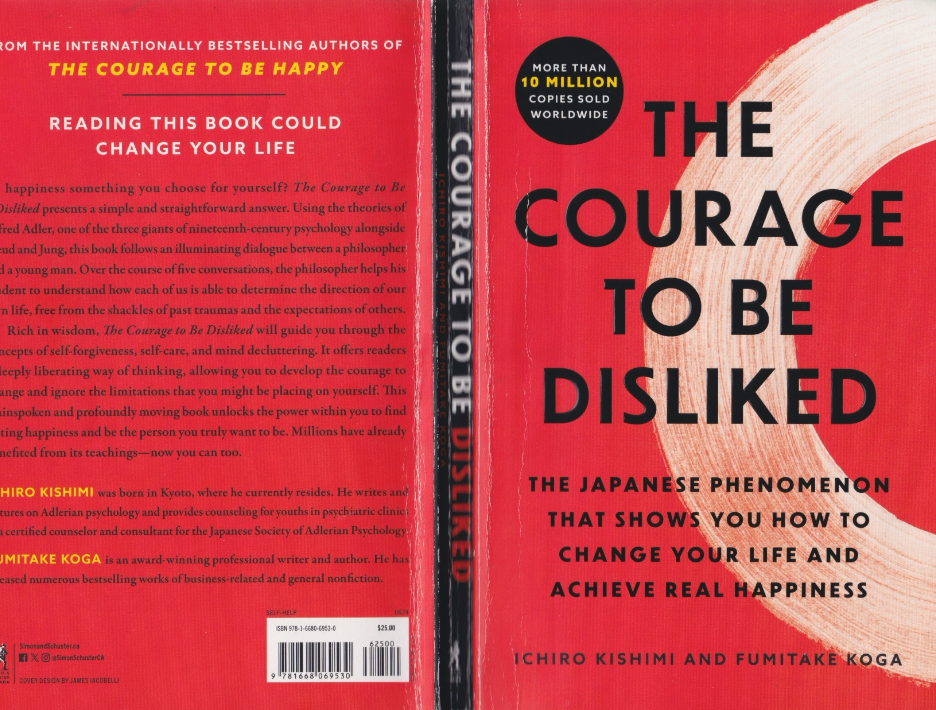
Auteur: Ichiro Kishimi et Fumitake Koga
Année de parution: Original 2013, traduction 2019, cette édition 2024.
Éditeur: Simon & Schuster
Lien vers mes notes manuscrites numérisées
En voici un autre review difficile à écrire. Si vous me voyiez en train de rédiger ceci, vous vous diriez sûrement que le texte n’a pas été ardu à composer. Je trouve moi-même que je suis en train d’écrire à une vitesse normale, adéquate. Je me suis installé à mon ordinateur et j’ai simplement commencé à écrire comme si c’était la chose la plus naturelle au monde. Or, en tant que lecteur, vous ne pourrez jamais connaître tout l’effort qui a dû être déployé pour qu’un paragraphe apparaisse sur une page, précisément parce que la construction du courage d’écrire, l’éclairage d’un nombre suffisant de doutes, sont des travaux muets, ou du moins qui n’atterrissent pas. Les paroles s’envolent, mais les écrits restent.
C’est parce que les écrits restent que ça prend tant de temps à se déniaiser pour écrire!
Si vous aviez une machine à remonter dans le temps, vous aurez constaté que le 10 mai avant 17h00 EST, ce texte a d’abord été publiée sous une forme incomplète, très, très incomplète. Tout ce qui figurait était le template des questions que j’utilise pour inspirer mon écriture et la liste des citations étoiles que j’ai recueillies dans ce livre. Je n’avais même pas pris la peine d’enlever certaines sections qui font partie de mon gabarit et qui ne se retrouvent que rarement dans le review final, par exemple, celle qui s’est démarquée pour Pride & Prejudice (lecture 143):
# :books: Vocabulaire
Alors.
Je suis en train d’écrire ceci.
Vous pouvez scroll jusqu’à la fin pour savoir ce que contiendra ce texte (des images, peut-être?), mais pour moi cela est impossible. Je dois d’abord l’écrire pour “savourer” le bonheur de passer rapidement à travers le texte.
Qu’est-ce qui est plus plaisant? Écrire une succession d’idées, ou les voir toutes organisées sur la page? Un des moments est unique, l’autre est …
Drrrrrrrrrrrrrrriiiiiiinnnnnnnggggggggg
Un deuxième colis vient d’être livré pendant que je tentais d’écrire une phrase. Pendant un bref instant, je me demande à quoi ressemble la vie de ce livreur qui vient de me porter mon colis. Est-il heureux? Il semblait heureux. Le savait-il? A-t-il réalisé son rêve? Connait-il sa mission? Il ne pourrait jamais se douter que j’ai eu toutes ces réflexions en recevant ce tube de crème solaire qu’a commandé ma femme.
Il ne saura jamais que pendant cinq minutes, toute mon énergie a été dépensée sur lui.
C’est quand j’ai ce genre de réflexion que je me mets à me demander, suis-je un cas unique? Suis-je le seul à avoir ce genre de réflexion “aléatoire” ? Combien de fois ai-je quitté un endroit en laissant quelqu’un avec le genre de réflexion que je viens d’avoir? Combien de temps cela a-t-il duré? Qu’est-ce que je donnerais pour pouvoir revenir sur mes pas et donner la réponse aux questions que cette personne se pose, en espérant secrètement pouvoir vivre cette même situation de son point de vue? Comment qualifierait-elle le “trouble” de vivre ce moment?
Merci de m’avoir suivi à travers ce nœud de pensée. Dieu bénisse la phrase qui m’a sauvé pendant tant de moments similaires où mes pensées s’emportaient en laissant derrière elles ma grosse carcasse immobile :
An accurate but useless idea is still useless.
—Made to Stick, p. 57
D’avoir réussi à retrouver cette idée à sa source exactement 40 lectures plus tard m’a fait vivre plusieurs choses. D’abord, wow, à quel point est-ce extraordinaire que ceci vient tout juste de se produire. Cette idée qui baignait dans mon subconscient, de façon floue, apprise, mais avec un doute de bien la transmettre, a pu être retrouvée grâce au système de d’apprentissage que j’ai découvert pour et par moi-même (je partage ce système dans mon livre, Apprendre sans anxiété). Une fois de plus, je viens de me démontrer à moi-même la valeur de ce système, valeur dont l’ampleur dépasse les mots. Je me souviens.
Je me souviens
Mais aussi, elle me rappelle cette vidéo de Robert Greene, mon idole du moment, intitulée La folie de ma méthode. Dans cette vidéo, il explique quelle est sa façon de travailler pour écrire un livre. Or, le cas de Robert est unique, entre autres parce qu’il a subi un accident (cardio-vasculaire?) qui l’a laissé avec un bras handicappé. Il ne peut pas écrire comme la plupart des gens, du moins pas à la même vitesse. Même chose pour la lecture.
Je crois que retrouver “an accurate but useless idea is still useless” m’a fait repenser à Robert Greene parce que je me demande si cette vidéo était inutile, au fond. Pourquoi nous enseigner une méthode hyper spécifique, nous qui ne sommes pas des auteurs de son calibre, nous qui avons probablement nos deux bras, nous qui n’aurons peut-être pas la discipline de suivre sa méthode ?
Je ne sais pas.
Je ne sais pas
En tout cas.
Parlons du livre de l’heure. The Courage to Be Disliked. En vérité, j’ai adoré ce livre. Peut-être trop. J’en étais contrarié quand je constatais que ma femme avait des problèmes avec certains des propos contenus dans le texte. Du moins, pas le contenu en soit. Juste la formulation d’idées qui étaient trop, comment dire… grossièrement généralisées à son goût, sans se soucier des détails et des cas plus extrêmes, nébuleux.
De quoi parle The Courage to Be Disliked ? C’est un dialogue entre Youth (un jeune) et Philosopher (un (vieux?) philosophe) sur le bonheur, la façon d’y parvenir, etc. Le jeune n’est pas satisfait de sa vie. Il sent que quelque chose ne va pas, sans vraiment savoir de quoi se plaindre. Il veut régler ses problèmes, il est motivé, mais il ne sait pas quoi essayer. Il a besoin de quelqu’un avec qui échanger des idées pour en recevoir des nouvelles et aiguiser celles auxquelles il tient précieusement.
Youth, c’est moi. Et Philosopher, c’est l’inconnu à qui j’ai (peut-être trop souvent) envie de donner toute ma confiance comme on donne sa vie à une bonne cause.
Je dois dire que le titre m’a tout de suite accroché. J’aimerais détenir le courage de déplaire. Combien de fois me suis-je empêché d’agir, me créant des regrets, par peur de déplaire ? Rester immobile par peur d’être exclus, d’avoir honte, de devoir défendre ma position ?
Ça m’est arrivé trop, trop, trop, trop, trop, trop, trop, trop
…
…
Seigneur. Vive Vim.
3k05wDpj24p1
trop, trop, trop, trop, trop, trop, trop, trop trop, trop, trop, trop, trop, trop, trop, trop trop, trop, trop, trop, trop, trop, trop, trop trop, trop, trop, trop, trop, trop, trop, trop trop, trop, trop, trop, trop, trop, trop, trop trop, trop, trop, trop, trop, trop, trop, trop trop, trop, trop, trop, trop, trop, trop, trop trop, trop, trop, trop, trop, trop, trop, trop trop, trop, trop, trop, trop, trop, trop, trop trop, trop, trop, trop, trop, trop, trop, trop trop, trop, trop, trop, trop, trop, trop, trop trop, trop, trop, trop, trop, trop, trop, trop trop, trop, trop, trop, trop, trop, trop, trop trop, trop, trop, trop, trop, trop, trop, trop trop, trop, trop, trop, trop, trop, trop, trop trop, trop, trop, trop, trop, trop, trop, trop trop, trop, trop, trop, trop, trop, trop, trop trop, trop, trop, trop, trop, trop, trop, trop trop, trop, trop, trop, trop, trop, trop, trop trop, trop, trop, trop, trop, trop, trop, trop trop, trop, trop, trop, trop, trop, trop, trop trop, trop, trop, trop, trop, trop, trop, trop trop, trop, trop, trop, trop, trop, trop, trop trop, trop, trop, trop, trop, trop, trop, trop
de fois.
Ce livre a évoqué plein de questions en moi. En voici quelques unes, dans un ordre approximativement compréhensible :
- Qui suis-je?
- Avant, écrire des reviews me faisait du bien. Est-ce encore le cas? Pourquoi je fais ça?
- Est-ce que je devrais bannir cette question de mon répertoire : “Est-ce que X est normal?”
- Les espoirs qui m’ont mené à lire ce livre ont-ils été satisfaits?
- Si chaque problème est à sa source un problème interpersonnel, comment va ma relation avec moi-même?
- Est-ce que je me déplais à moi-même? Est-ce que ça me demanderait du courage de me déplaire à moi-même?
- Mes transitions d’emploi des dernières années m’ont fait mal (trois en trois ans). Me suis-je développé une carapace? Est-ce que j’en garde des cicatrices? Quels sont mes apprentissages?
- Il y a certaines personnes que j’aimerais qu’elles lisent ce review. J’aimerais qu’elles approuvent de moi, mais j’ai la presque certitude qu’elles ne le liront pas. Est-ce de ces personnes dont je pourrais ne pas avoir besoin dans ma vie? Ceux pour qui je devrais utiliser le courage de déplaire?
- À ma mort, quand tout pour moi sera terminé,
- Qu’est-ce que j’aurai changé?
- Qui se souviendra de moi?
- Est-ce que ça mérite qu’on s’en souvienne?
- Pourquoi je veux qu’on se souvienne?
- Qu’est-ce que cette quête du savoir me coûte? Est-ce l’impression de vivre comme un mort?
Le philosopher en moi a envie de répondre, “c’est beaucoup de questions, ça, cher youth. C’est correct. Mettons-les de côté pour l’instant. C’est à mon tour de parler.”
mental health update
Vous savez, la santé mentale, c’est tellement important d’en parler, au moins une fois par semaine. Juste pour se rappeler que ça existe. Que les gens souffrent. Qu’ils ne savent pas quoi dire. Mais qu’ils ont besoin de quelqu’un de disponible.
Ces dernières semaines, j’ai été cette personne. Je ne comprends pas mes humeurs. Je catastrophise sur plein de choses. Je me sens serré financièrement, ça vient me chercher dans des émotions vraiment core, et je me sens seul, incompris dans cette situation. J’aimerais remonter sans rabaisser quelqu’un. Je ne sais pas quoi faire. Je ne veux choquer personne. Un cri en pianissimo: aaaaa…
Ce livre a été une mini-révélation pour moi, parce que ça m’a aidé à retrouver, à revisualiser, à comprendre autrement ce qu’est une relation, une relation saine, celle qui permet d’entrer en relation avec soi-même et de se sentir complet. La formule du dialogue entre youth et Philosopher était parfaitement adaptée au propos et m’a fait du bien à l’âme.
J’ai l’impression que je pense à chaque jour à la mort. Pas comme quelque chose d’effrayant à éviter. Pas non plus comme quelque chose vers quoi me précipiter. Plutôt comme quelque chose qui viendra en son temps, et que le moment venu je serai prêt comme lorsque vient le temps de se coucher après une longue journée de travail.
Il y a des moments où j’ai l’impression que je ne suis pas compris par ceux qui m’entourent. Comme si j’étais déphasé, né à la mauvaise époque. Que ce soit parce que je suis plus intelligent ou plus stupide ne ferait pas de différence : dans les deux cas, la connexion cherchée ne se fait pas assez souvent à mon goût.
Je me sens à la recherche de Socrate. Je ne sais pas ce qu’il m’apprendra, mais je vais le trouver.
Je veux devenir l’ami de Socrate. Je ressens ce besoin.
À nous deux, Platon.
Ça vous servira peut-être d’indice sur une des prochaines reviews à apparaître sur ce site.

Quelques citations du livre
- (p. 54) “There is no such thing as worry that is completely defined
by the individual; so-called internal worry does not exist. Whatever
the worry that may arise, the shadows of other people are always
present.
- What about worrying over your own health?
- (p. 89) The conviction that “I am right” leads to the assumption that “this person is wrong,” and finally it becomes a contest and you are thinking, “I have to win.”
- (p. 93) Work that can be completed without the cooperation of other people is in principle unfeasible.
- (p. 99) Self-reliance as an individual and cooperation within society are overarching objectives that can be achieved by surmounting the three tasks of work, friendship, and love, the tasks of the interpersonal relationships that a living person
- (p. 115) There is no need to be recognized by others. One must not seek recognition.
- (p. 124) (The notion of separating tasks) There is a simple way to tell [to whom belongs a task]. Think, “Who ultimately is going to receive the result brought about by the choice that is made?”
- (p. 169) [I am my life’s protagonist, but not the world’s protagonist.]
- (p. 180) When one person praises another, the goal is “to
manipulate someone who has less ability than you.” It is not done
out of gratitude or respect.
- Do I actually agree with this? I can see how this is true for the praise I receive. However, I believe the praise I give is genuine…
- (p. 181) Adlerian psychology refutes all manner of vertical relationships and proposes that all interpersonal relationships be horizontal relationships. In a sense, this point may be regarded as the fundamental principle of Adlerian psychology.
- (p. 186) Giving praise is a judgment that is passed by a person of ability onto a person without ability.
- (p. 188) Being praised essentially means that one is receiving judgment from another person as “good.” And the measure of what is good or bad about that act is that person’s yardstick. If receiving praise is what one is after, one will have no choice but to adapt to that person’s yardstick and put the brakes on one’s own freedom. “Thank you,” on the other hand, rather than being judgment, is a clear expression of gratitude. When one hears words of gratitude, one knows that one has made a contribution to another person.
- (p. 197) If you are building even one vertical relationship with someone, before you even notice what is happening, you will be treating all your interpersonal relations as vertical. On the other hand, if one has managed to build a horizontal relationship with at least one person–if one has been able to build a relationship of equals in the true sense of the term–that is a major lifestyle transformation. With that breakthrough, all one’s interpersonal relations will gradually become horizontal.
- (p. 246) (illustrate) Do not treat [life] as a line. Think of life as a series of dots. If you look through a magnifying glass at a solid line drawn with chalk, you will discover that what you thought was a line is actually a series of small dots. Seemingly linear existence is actually a series of dots; in other words, life is a series of moments.
- (p. 251) If the goal of climbing a mountain were to get to the top, that would be a kinetic act. To take it to the extreme, it wouldn’t matter if you went to the mountaintop in a helicopter, stayed there for five minutes or so, and then headed back in the helicopter again. Of course, if you didn’t make it to the mountaintop, that would mean the mountain-climbing expedition was a failure. However, if the goal is mountain climbing itself, and not just getting to the top, one could say it is energial. In this case, in the end it doesn’t matter whether one makes it to the mountaintop or not.
- (p. 258) “I think this discussion has now reached the water’s edge. Whether you drink the water or not is now entirely up to you.
💡 Nouvelles idées
- Relations horizontales et verticales
- Chaque problème est à sa source un problème interpersonnel
- Exercer sa liberté nécessite de déplaire à quelqu’un
⭐ Citations étoiles
Introduction
The First Night: Deny Trauma
The Unknown Third Giant
Why People Can Change
Trauma Does Not Exist
- (p. 13) ⭐ “We are not determined by our experiences, but the meaning we give them is self-determining.” –Alfred Adler
People Fabricate Anger
How to Live Without Being Controlled by the Past
- (p. 21) Regardless of what may have happened in the past, it is the meaning that is attributed to it that determines the way someone’s present will be.
Socrates and Adler
Are You Okay Just As You Are?
Unhappiness Is Something You Choose for Yourself
People Always Choose Not to Change
Your Life Is Decided Here and Now
- (p. 37) Saying “If only I could be like Y” is an excuse to yourself for not changing.
The Second Night: All Problems Are Interpersonal Relationship Problems
Why You Dislike Yourself
All Problems Are Interpersonal Relationship Problems
- (p. 52) Being alone isn’t what makes you lonely. Loneliness is having other people and society and community around you, and having a deep sense of being excluded from that. To feel lonely, we need other people.
- (p. 53) ⭐ All problems are interpersonal relationship problems.
Feelings of Inferiority Are Subjective Assumptions
- (p. 59) ⭐ Value is something that’s based on social context.
An Inferiority Complex Is an Excuse
Braggarts Have Feelings of Inferiority
- (p. 65) No one is capable of putting up with having feelings of inferiority for a long period of time. Feelings of inferiority are something that everyone has, but staying in that condition is too heave to endure forever.
- (p. 68) Those who make themselves look bigger on borrowed power are essentially living according to other people’s value systems—they are living other people’s lives.
- (p. 68) The one who boasts does so only out of a feeling of inferiority. […] If one really has confidence in oneself, one doesn’t feel the need to boast.
- (p. 71) ⭐ ⭐ As long as one continues to use one’s misfortune to one’s advantage in order to be “special,” one will always need that misfortune.
Life Is Not a Competition
You’re the Only One Worrying About Your Appearance
From Power Struggle to Revenge
Admitting Fault Is Not Defeat
- (p. 87) ⭐ Admitting fault is not defeat.
Overcoming the Tasks That Face You in Life
- (p. 91) There are two objectives for behavior: to be self-reliant and to live in harmony with society. Then, the two objectives for the psychology that supports these behaviors are the consciousness that “I have the ability” and the consciousness that “people are my comrades.”
Red String and Rigid Chains
- (p. 96) Instead of waiting for others to change or waiting for the situation to change, […] take the first step forward yourself.
- (p. 97) Relationships in which people restrict each other eventually fall apart.
Don’t Fall for the “Life-Lie”
From the Psychology of Possession to the Psychology of Practice
The Third Night: Discard Other People’s Tasks
Deny the Desire for Recognition
Do Not Live to Satisfy the Expectations of Others
- (p. 118) If you are not living to satisfy other people’s expectations, it follows that other people are not living to satisfy your expectations.
How to Separate Tasks
Discard Other People’s Tasks
How to Rid Yourself of Interpersonal Relationship Problems
Cut the Gordian Knot
- (p. 136) “Children who have not been taught to confront challenges will try to avoid all challenges.” –Adler
The Desire for Recognition Makes You Unfree
- (p. 139) If one is deciding one’s path oneself, it’s only natural that one will get lost at times.
- (p. 141) There is no reason of any sort that one should not live one’s life as one pleases.
What Real Freedom Is
- (p. 142) No one would go so far as to actually want to be disliked.
- (p. 144) Freedom is being disliked by other people. […] It is proof that you are exercising your freedom and living in freedom, and a sign that you are living in accordance with your own principles.
- (p. 144) There is a cost incurred when one wants to exercise one’s freedom And the cost of freedom in interpersonal relationships is that one is disliked by other people.
- (p. 146) Don’t want to be disliked, but […] don’t mind if you are.
You Hold the Cards to Interpersonal Relationships
The Fourth Night: Where the Center of the World Is
Individual Psychology and Holism
- (p. 160) Forming good interpersonal relationships requires a certain degree of distance.
The Goal of Interpersonal Relationships Is a Feeling of Community
- (p. 163) Interpersonal relations are the source of unhappiness. And the opposite can be said, too–interpersonal relations are the source of happiness.
Why Am I Only Interested in Myself?
- (p. 166) The fact that there are people who do not think well of you is proof that you are living in freedom.
You Are Not the Center of the World
- (p. 169) Other people are not living to satisfy your expectations.
- (p. 171) A sense of belonging is something that one acquires through one’s own efforts [by committing and giving to members of the community]–it is not something one is endowed with at birth.
Listen to the Voice of a Larger Community
- (p. 177) Living in fear of one’s relationships falling apart is an unfree way to live, in which one is living for other people.
Do Not Rebuke or Praise
- (p. 182) The feeling of inferiority is an awareness that arises within vertical relationships. If one can build horizontal relationships that are “equal but not the same” for all people, there will no longer be any room for inferiority complexes to emerge.
The Encouragement Approach
- (p. 185) The more one is praised by another person, the more one forms the belief that one has no ability [because] giving praise is a judgment that is passed by a person of ability onto a person without ability.
- (p. 186) When receiving praise becomes one’s goal, one is choosing a way of living that is in line with another person’s system of values.
How to Feel You Have Value
- (p. 189) ⭐ [Our sense of worth comes from our sense of usefulness to our community]
Exist in the Present
People Cannot Make Proper Use of Self
The Fifth Night: To Live in Earnest in the Here and Now
Excessive Self-Consciousness Stifles the Self
Not Self-Affirmation–Self-Acceptance
- (p. 209) There is no need to go out of one’s way to be positive and affirm oneself. It’s not self-affirmation that we are concerned with, but self-acceptance.
- (p. 211) ⭐ The Serenity Prayer (Kurt Vonnegut): “God grant me the serenity to accept the things I cannot change; courage to change the things I can; and wisdom to know the difference.”
The Difference Between Trust and Confidence
- (p. 214) The opposite of confidence is doubt.
The Essence of Work Is a Contribution to the Common Good
Young People Walk Ahead of Adults
Workaholism Is a Life-Lie
- (p. 230) A way of living that acknowledges only company work is one that is lacking in harmony of life. Work in the home, child-rearing, contributing to the local society, hobbies, and all manner of other things are work.
You Can Be Happy Now
- (p. 233) For a human being, the greatest unhappiness is not being able to like oneself. […] The feeling of “I am beneficial to the community” or “I am of use to someone” is the only thing that can give one a true awareness that one has worth.
- (p. 234) You are not the one who decides if your contributions are of use. That is the task of other people, and is not an issue in which you can intervene. In principle, there is not even any way you can know whether you have really made a contribution.
- (p. 236) One can have happiness only if one has freedom.
Two Paths Traveled by Those Wanting to Be “Special Beings”
The Courage to Be Normal
- (p. 243) Being normal is not being incapable. One does not need to flaunt one’s superiority.
Life Is a Series of Moments
Live Like You’re Dancing
- (p. 249) Life is a series of moments, which one lives as is one were dancing, right now, around and around each passing instant. […] With dance, it is the dancing itself that is the goal, and no one is concerned with arriving somewhere by doing it.
- (p. 250) You should be on a journey the moment you step outside your home, and all the moments on the way to your destination should be a journey. Of course, there might be circumstances that prevent you from making it to [your destination,] but that does not mean you didn’t go on a journey.
Shine a Light on the Here and Now
The Greatest Life-Lie
- (p. 257) The greatest life-lie of all is to not live here and now. It is to look at the past and the future, cast a dim light on one’s entire life, and believe that one has been able to see something.
Give Meaning to Seemingly Meaningless Life
- (p. 260) When one attempts to choose freedom, it is only natural that one may lose one’s way.
- (p. 261) No matter what moments you are living, or if there are people who dislike you, as long as you do not lose sight of the guiding star “I contribute to others,” you will not lose your way, and you can do whatever you like.
Afterword
- (p. 268) In philosophy, it is the very process of learning what one does not know and arriving at wisdom that is important. Whether or not one attains wisdom in the end is not an issue.
-
Ne perdez pas trop votre temps, ceci est un mensonge. ↩︎