25 minutes
On Writing Well
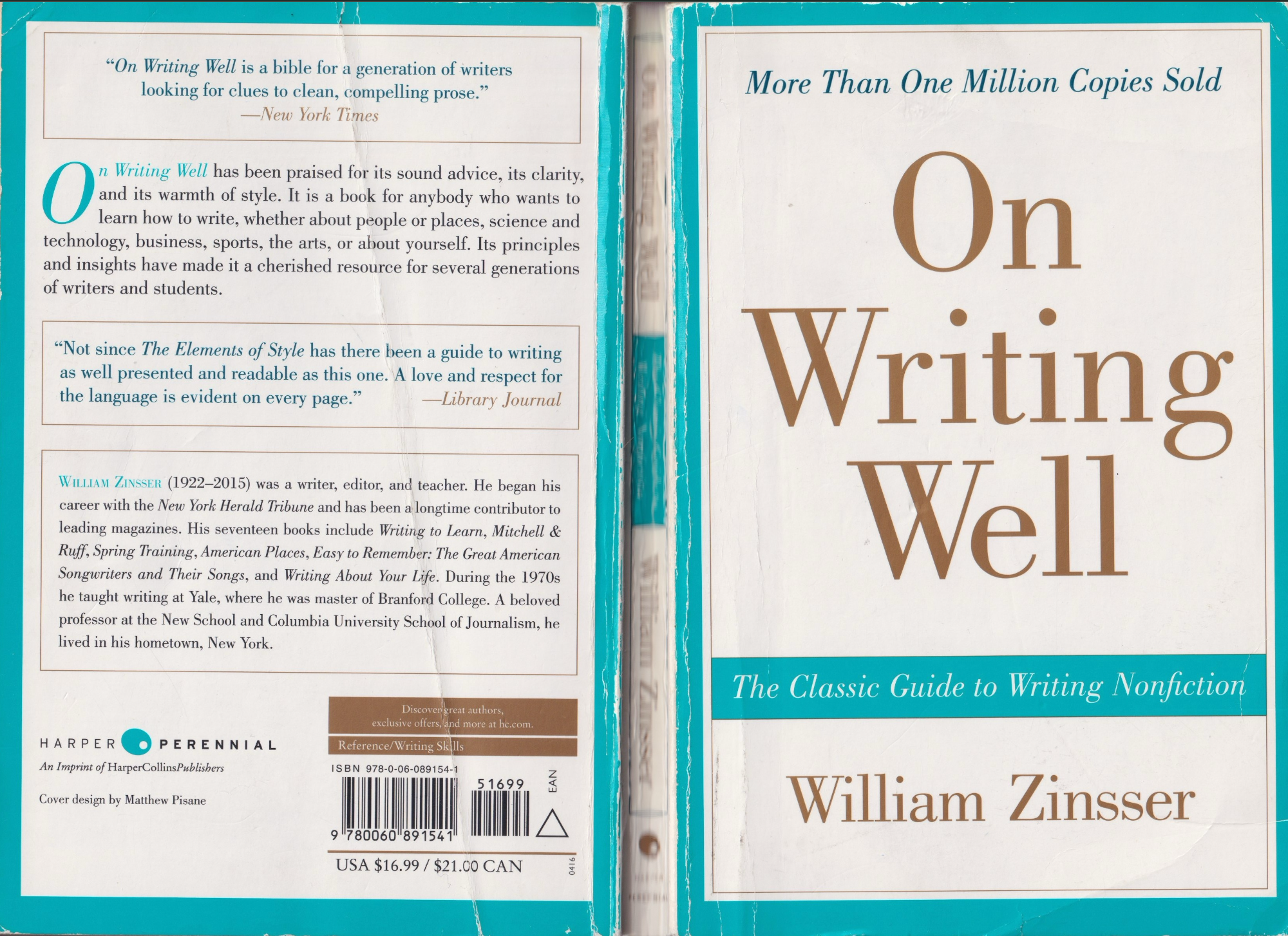
Auteur: William Zinsser
Année de parution: 2006
Éditeur: Harper Perennial
Lien vers mes notes manuscrites numérisées
Je vais commencer ce texte avec un aveu. Je ressens une pression d’écrire un texte excellent en ce moment. Comment ne pourrait-il pas en être ainsi? Je viens de terminer de lire un classique de la littérature anglophone, On Writing Well. Ce livre a reçu sept éditions depuis sa première parution en 1976 et a vendu plus d’un million d’exemplaires. Ça se voit, et ça se sent. L’auteur offre plein d’idées et d’images géniales qui permettent de faire la différence entre quelque chose de bien et de mal écrit. Car il y a une différence: il y a presque toujours une bonne et une “mauvaise” façon d’écrire, ou encore de simplement dire quelque chose. Les mots qu’on choisit non seulement trahissent la clarté de notre esprit, mais ils peuvent aider ou nuire à la compréhension d’un lecteur de ce qu’on tente de leur dire.
Voyez, peut-être que la dernière phrase du paragraphe précédent n’est pas bien écrite. Peut-être que j’aurais pu dire en termes plus simples: si tu comprends ce que je dis du premier coup, c’est probablement parce que je l’ai bien écrit. Or, c’est rarement du premier coup que je réussirai à écrire quelque chose qui te permettra de le comprendre immédiatement. Tu vois la nuance?
Oh, et permets-moi de te tutoyer tout au long de ce texte. J’essaie quelque chose, et on verra si c’est une formule qu’on voudra conserver dans un prochain texte. Ce quelque chose, c’est le ton qu’utilise Zinsser dans son écriture qui crée un lien direct entre lui-même et le lecteur. Ça «coule», ça sonne bien, et c’est surtout très clair.
En me permettant de te tutoyer de la sorte, je remarque deux choses. D’abord, je suis vraiment surpris que je n’aie pas osé faire cela avant. C’est curieux, pourtant. J’assumais qu’éventuellement il y aurait des dizaines de personnes qui liraient ces textes. Or, chacun lira ce texte dans l’intimité, probablement en solitaire, et donc quand j’écris “vous”, c’est comme si je te vouvoyais. Cela crée un mur invisible entre toi et moi, et c’est bien la dernière chose que je souhaite faire—rajouter un nouveau mur—alors qu’il y a déjà tant de murs qui nous séparent. Je défais donc ce mur intellectuel inutile, et je me contenterai de laisser les murs physiques nous séparer autant qu’ils le veulent. Hey, qui sait, peut-être qu’on se rencontrera un jour. Peut-être même qu’on se connait déjà et que ces mots pourraient te servir de signal pour m’inviter à faire quelque chose ensemble.
Whoops, est-ce que je suis en train de m’écarter? En train de trop prendre goût à cette nouvelle relation qui se dessine entre toi et moi? Revenons donc aux propos du livre afin de faire un inventaire des idées que j’ai pu en retirer.
Et j’écris tout ça en me demandant si je réussirai à intégrer les bonnes pratiques recommandées par l’auteur. Aïe aïe aïe, ça va être tout un exercice, mais ô comment excellent aussi!
⁂
Voici un premier exemple d’une remarque du livre qui m’a bien fait réfléchir:
(p. 54) The most important sentence in any article is the first one. If it doesn’t induce the reader to proceed to the second sentence, your article is dead.
La première phrase de mon texte était: «Je vais commencer ce texte avec un aveu.» (en tout cas, au moment d’écrire ces lignes.) J’espère que c’est toujours celle-là qui vous a introduit au texte, et si elle a changé, que j’ai aussi pensé à mettre à jour ce paragraphe. Qu’en pensez-vous? Trouvez-vous que j’ai réussi à suivre les conseils de Zinsser? Moi, je la trouve pas mal, en tout cas, certainement assez bonne pour continuer à écrire la suite de ce texte sans ressentir le besoin de revenir en arrière pour retravailler les mots précédents. C’est un sentiment agréable, mais ce n’est certainement pas une indication que mon travail est terminé. Car voilà ce que nous apprend Zinsser dans son livre, que j’ai entendu répété à plusieurs sauces, mais qui est vraiment le point essentiel du livre: Écrire, c’est réécrire.
Prenez par exemple les mots que je suis en train d’«écrire» ici. Il s’agit en ce moment de mon premier jet. Je note simplement les idées qui me viennent à l’esprit, dans l’ordre séquentiel qu’elles apparaissent. Oui, techniquement j’ai formé des mots, et donc j’ai écrit quelque chose. Mais l’Écriture, avec un grand É, ne commencera pas tant que je ne relirai pas ce que je viens d’écrire afin de rendre les phrases agréables à lire, sans fautes évidentes, logiques, et rythmées.
Pendant qu’on y est, j’ai une autre question pour toi. Trouves-tu que j’ai bien respecté cet autre conseil de Zinsser?
(p. 203) You must make an immediate effort to orient your readers to the special world they are about to enter. [That is how a good piece of criticism should start.]
Alors, te sens-tu orienté? Prends bien ton souffle, car je t’emmène sur une autre pépite:
(p. 55) Take special care with the last sentence of each paragraph—it’s the crucial springboard to the next paragraph.
…
Honnêtement, avec le petit paragraphe précédent, aussi bizarre que ça puisse paraître, j’ai l’impression que j’aurais difficilement pu faire mieux. Je suis prêt à dire que c’était un simple «happy accident» comme dirait un de mes (et de tes?) héros personnels: Bob Ross.
(p. 55) Make the reader smile and you’ve got him for at least an extra paragraph.
Est-ce que je t’ai fait sourire en parlant de Bob Ross? Ha! Ça veut dire que t’es encore pris avec moi, au moins pour la prochaine section.
⁂
J’aimerais vraiment trouver une façon de voir quels éléments du livre provienne de chacune de ses éditions. Écrire un livre comme celui-là est l’œuvre d’une vie. C’est parce que ça demande d’avoir lu tellement de textes pour pointer la différence précise qui détermine si un texte est bon ou pas. Et elle est précise, c’est ça qui est incroyable. Je crois qu’elle se résonne bien quand l’auteur mentionne:
(p. 20) It’s amazing how often an editor can throw away the first few paragraphs of an article, or even the first few pages, and start with the paragraph where the writer begins to sound like himself or herself.
Une des choses les plus importantes quand on écrit bien, c’est qu’on sonne comme soi-même. Quand on parle… Non, minute. Je vais parler pour moi. (Tu peux t’inclure ou non là-dedans, ton choix.) Quand je parle, je suis détendu, j’explique bien et simplement les choses, et les gens autour de moi, la plupart du temps, me comprennent. (Il y a peut-être juste ma fiancée Gabrielle qui, elle, aurait l’impression que pendant des journées entières je ne parviens pas à me faire simplement comprendre—je t’aime mon amour.) Au début de ce texte, celui que je suis encore en train d’écrire en mode premier jet, je le sens. Je suis beaucoup plus moi-même maintenant que dans les premières lignes. Dans les premières lignes j’étais encore en train de réfléchir, de me demander quel angle donner à mon train de pensée et à ce texte en entier. Mais en ce moment, c’est vroum. Je me promène entre les miettes de pain que je me suis laissées au début de mon processus d’écriture et je ne fais que remplir les trous jusqu’à ce que je manque d’inspiration ou que je décide de terminer une bien trop longue phrase.
⁂
(p. 52) Decide what single point you want to leave in the reader’s mind. […] Every successful piece of nonfiction should leave the reader with one provocative thought that he or she didn’t have before. Not two thoughts, or five—just one.
Ce passage, initialement, m’a choqué. Je n’étais pas d’accord. Je pensais à mon livre, qui tente de partager plein d’idées avec le lecteur. Je pensais au livre que j’étais en train de tenir entre mes mains, On Writing Well, qui à lui seul contenait déjà plus d’idées que ce que je pouvais trouver dans mon livre.
Mais après, comme toujours, j’ai compris de quoi l’auteur parlait vraiment et là je me suis raccordé à son point. C’est intéressant de faire l’effort de résumer tout ce qu’on dit à un seul point qu’on souhaite laisser dans l’esprit du lecteur. C’est nécessaire. Ne pas l’essayer, c’est laisser tomber son écriture, parce que ça ne connecte pas les choses ensembles. Ça ne peux pas tenir dans la tête du lecteur.
Quel est donc ce point singulier que j’avais envie de laisser dans la tête des lecteurs avec mon livre Apprendre sans anxiété? C’était une question embêtante, et c’est encore plus embêtant que c’est littéralement la première fois que je réfléchis à cette question par écrit. Il est temps d’arriver avec une première réponse, et je vous promets que je ne terminerai (… scuse, je t’ai vouvoyé, c’était un accident, donne-moi encore le temps de m’habituer…) pas de finir ce texte avant d’avoir une réponse satisfaisante à cette question.
Trouver son confort en se poussant à essayer de nouvelles choses.
Voilà, ce n’était pas si difficile!1
Pourquoi est-ce la bonne idée? Eh bien, j’ai vu il y a quelques années un épisode d’Infoman où Jean-René Dufort disait que le confort est la drogue la plus addictive au monde. C’est une information pas simplement triste; elle est utile. On peut l’utiliser comme levier. Si l’on parvient à rendre confortable le fait d’essayer de nouvelles choses, on vient littéralement de gagner au jeu de la vie. Pourquoi?
Parce que changer sa vie, c’est difficile. Souvent, on est pris dans nos problèmes qui sont propres à nous. Personne ne l’a vécu avant et personne ne peut nous dire exactement comment s’en sortir. Pour moi, c’était les tomates. Manger une tomate, c’était une des idées les plus attroces pour moi. C’était le cas jusqu’à il y a environ 11 ans. Il y a quelque chose dans le mix entre la texture et le goût sucré-mais-pas-sucré-comme-le-ketchup de la tomate qui était, pour utiliser un terme anglais, off-putting pour moi. Mais aujourd’hui, manger une tomate n’est pas un problème. Qu’est-ce qui a changé?
Simplement le fait que j’ai réalisé ce que ne pas être capable de manger une tomate m’empêche de vivre. Quand je devais dire, pendant une fête par exemple, que je voulais une assiette sans tomates, je me sentais toujours comme le mec bizarre de la place, celui qui fait son difficile ou son intéressant, et qui ne savait pas réellement ce qu’il manquait en refusant de profiter de ces «délicieuses tomates». J’ai pesé le pour et le contre et j’ai réalisé que c’était assez, que je voulais beaucoup plus d’une vie qui me permettrait de ne pas avoir à vivre des émotions négatives quand une tomate est visible dans une cuisine, ce qui arrive souvent, car les tomates en réalité sont vraiment délicieuses! Vous voyez ce que je veux dire?
Alors, la question se pose maintenant, quel était donc ce point singulier que je souhaite laisser dans ton esprit une fois que tu as fini de lire ce texte? Honnêtement, il a fallu que je m’arrête pour y penser vraiment. La première chose qui me vient en tête, c’est que j’aurai toujours une dette envers ce livre, qui m’a fait réaliser tant de choses. Je suis content de les avoir réalisées maintenant, parce que le reste de tout ce que j’écrirai au fil de ma vie en bénéficiera. Je ne peux qu’imaginer le résultat final. J’ai hâte. Je me trouve chanceux de pouvoir vivre cette vie. Je n’ai jamais autant aimé écrire qu’aujourd’hui, et (me semble que ça serait un moment vraiment beau pour pleurer, mais je ne peux pas pleurer sur demande, donc je vais juste sourire beaucoup) ça n’a pas de prix.
(p. 64) If you have presented all the facts and made the point you want to make, look for the nearest exit.
C’est mon stop! À bientôt.
📚 Vocabulaire
- avocation (p. 3): hobby, customary employment
- mollify (p. 7): to pacify, to calm the anger of, to soothe
- august (p. 19): marked by majestic dignity or grandeur
- crotchet (p. 26): an odd, whimsical, or stubborn notion
- antinomianism (p. 28): the belief that people who are under grace are not bound to follow God’s moral law.
- picayune (p. 41): A Spanish half real piece formerly current in the South; something trivial
- flotsam (p. 43): floating wreckage of a ship or its cargo; debris, remains, unimportant material
- fitfully (p. 68): irregularly or unsteadily
- limerick (p. 77): a form of verse that appeared in England in the early years of the 18th century. Exemple: The limerick packs laughs anatomical / Into space that is quite economical / But the good ones I’ve seen / So seldom are clean / And the clean ones so seldom are comical. [An old drinking song.]
- laconic (p. 90): using or involving the use of a minimum of words: concise to the point of seeming rude or mysterious
- wantonness (p. 123): The trait of lacking restraint or control; reckless freedom from inhibition or worry
- pathos (p. 129): complaints of the soul. In Greek, appeal to the emotions and ideals of an audience, eliciting feelings that already reside in them.
- preternaturally (p. 188): exceeding what is natural or regular (extraordinary). Inexplicable by ordinary means (psychic).
- *verities (p. 234): plural of verity: something (e.g. a statement) that is true or real. [Une vérité.]
- fickleness (p. 234): fickle: marked by lack of constancy or stability: erratic
- to lilt (p. 235): to sing or play in a lively cheerful manner
- vernacular (p. 235): using a language or dialect native to a region or country rather than a literary, cultured, or foreign langage. Nonstandard, dialect of a place.
- trite (p. 238) boring from much use: not fresh or original.
- eloquence (p. 238): discourse marked by force and persuasiveness. The quality of forceful or persuasive expressiveness.
- blithe (p. 242): lacking thought or consideration. Of a happy lighthearted character or disposition.
- dour (p. 252): stern, harsh
- tawdry (p. 260): cheap or gaudy in appearance or quality
💡 Nouvelles idées
-
Quand je prends des notes manuscrites, je mets un 💭 à côté d’une idée de l’auteur pour faire la différence entre ses idées et les miennes.
-
💭 Bien écrire, c’est bien parler, car éventuellement on écrit dans le but de lire nos textes à voix haute.
Aussi, “Never say anything in writing that you wouldn’t comfortably say in conversation.”
-
(p. 36) ⭐ “I write entirely by ear and read everything aloud before letting it go into the world.”
-
💭 Je n’écris pas des critiques de livres. J’écris des textes en réaction aux livres que j’ai lus. Les livres que je lis sont à la fois de la nourriture pour mon âme et une excuse pour me motiver à écrire.
-
(p. 109) Remember that you can call the person you interviewed. Tell him you want to check a few of the things he said. Get him to rephrase his points until you understand them. Don’t become a prisoner of your quotes.
- J’aime “Don’t become a prisoner of your quotes.” L’auteur écrit ça dans le contexte d’un interview, mais je suis intéressé de constater que c’est aussi vrai dans le cas de la lecture d’un livre. Au fond, quand je lis un livre, c’est comme si j’écoute la réponse (très) détaillée à une question que je me pose. Or, j’en retiens des citations, et je les utilise dans mes reviews. C’est une bonne notion à garder en tête, l’importance de ne pas devenir prisonnier de ses citations. Par exemple, cela me donnerait la permission (avec une transparence intellectuelle, bien sûr) de découper des phrases et de les assembler ensemble afin de leur donner un sens plus direct.
⭐ Citations étoiles
Introduction
- (p. xii) The essence of writing is rewriting.
Part I: Principles
Chapter 1: The Transaction
- (p. 4) The professional writer must establish a daily schedule and stick to it.
- (p. 4) Writing is a craft, not an art, and the man who runs away from his craft because he lacks inspiration is fooling himself.
- (p. 4) If your job is to write every day, you learn to do it like any other job.
- (p. 5) Ultimately the product that any writer has to sell is not the subject being written about, but who he or she is.
- (p. 5) What holds [the reader] is the enthusiasm of the writer for his field. How was he drawn into it? What emotional baggage did he bring along? How did it change his life?
Chapter 2: Simplicity
- (p. 6) The secret of good writing is to strip every sentence to its
cleanest components.
- Every word that serves no function
- Every long word that could be a short word
- Every adverb that carries the same meaning that’s already in the verb
- Every passive construction that leaves the reader unsure of who is doing what
- (p. 8) If the reader is lost, it’s usually because the writer hasn’t been careful enough.
- (p. 9) Writers must […] constantly ask; what am I trying to say? […] Then they must look at what they have written and ask: have I said it?
- (p. 9) A clear sentence is no accident. Very few sentences come out right the first time, or even the third time.
Chapter 3: Clutter
- (p. 16) ⭐ ⭐ Be grateful for everything you can throw away. […] Are you hanging on to something useless just because you think it’s beautiful?
Chapter 4: Style
- (p. 18) You have to strip your writing down before you can build it back up.
- (p. 20) “What I’m always looking for as an editor is a sentence that says something like ‘I’ll never forget the day when I…’ I think, ‘Aha! A person!’ "
- (p. 20) Writing is an intimate transaction between two people, conducted on paper, and it will go well to the extent that it retains its humanity. Therefore, […] write in the first person: “I” and “me” and “we” and “us.”
- (p. 23) Believe in your own identity and your own opinions. Writing is an act of ego, and you might as well admit it. Use its energy to keep yourself going.
Chapter 5: The Audience
- (p. 24) “Who am I writing for?” It’s a fundamental question, and it has a fundamental answer: You are writing for yourself.
- (p. 24) Don’t worry about whether the reader will “get it” if you indulge in a sudden impulse for humor. If it amuses you in the act of writing, put it in. (It can always be taken out, but only you can put it in.)
- (p. 26) Never say anything in writing that you wouldn’t comfortably say in conversation. If you’re not a person who says “indeed” or “moreover,” or who calls someone an “individual” […] please don’t write it.
Chapter 6: Words
- (p. 36) ⭐ “I write entirely by ear and read everything aloud before letting it go into the world.”
Chapter 7: Usage
Part II: Methods
Chapter 8: Unity
- (p. 49) The only way to learn to write is to force yourself to produce a certain number of words on a regular basis.
- (p. 52) Every successful piece of nonfiction should leave the reader with one provocative thought that he or she didn’t have before. Not two thoughts, or five—just one.
Chapter 9: The Lead and the Ending
- (p. 54) The most important sentence in any article is the first one. If it doesn’t induce the reader to proceed to the second sentence, your article is dead.
- (p. 55) Take special care with the last sentence of each paragraph—it’s the crucial springboard to the next paragraph.
- (p. 55) Make the reader smile and you’ve got him for at least an extra paragraph.
- (p. 64) “Something I often do in my writing is to bring the story full circle—to strike at the end an echo of a note that was sounded in the beginning. It gratifies my sense of symmetry, and it also pleases the reader, completing with its resonance the journey we set out together.”
- (p. 64) What usually works best [for an ending] is a quotation […], some remark that has a sense of finality or that’s funny, or that adds an unexpected closing detail.
Chapter 10: Bits and Pieces
- (p. 68) Most adverbs are unnecessary. […] Choose a verb that has a specific meaning […]. Don’t tell us that the radio blared loudly; “blare” connotes loudness.
- (p. 70) The adjective that exists solely as decoration is a self-indulgence for the writer and a burden for the reader. […] Make your adjectives do work that needs to be done.
- (p. 70) ⭐ Don’t say you were a bit confused and sort of tired and a little depressed and somewhat annoyed. Be confused. Be tired. Be depressed. Be annoyed. Don’t hedge your prose with little timidities. Good writing is lean and confident.
- (p. 70) Don’t be kind of bold. Be bold.
- (p. 71) Resist using an exclamation point to notify the reader that you are making a joke or being ironic.
- (p. 71) Humor is best achieved by understatement, and there’s nothing subtle about an exclamation point.
- (p. 74) Always make sure your readers are oriented. Always ask yourself where you left them in the previous sentence.
- (p. 77) Don’t inflate an incident to make it more outlandish than it actually was. If the reader catches you in just one bogus statement that you are trying to pass off as true, everything you write thereafter will be suspect. It’s too great a risk, and not worth taking.
- (p. 78) Forget the competition and go at your own pace. Your only contest is with yourself.
- (p. 79) Surprisingly often a difficult problem in a sentence can be solved by simply getting rid of it.
- (p. 83) 💭 Au lieu de parler en général de “lecteurs,” etc., l’auteur recommande d’adresser le lecteur directement quand on lui donne des instructions (“vous”).
- (p. 84) Most rewriting consists of reshaping and tightening and refining the raw material you wrote on your first try. Much of it consists of making sure you’ve given the reader a narrative flow he can follow with no trouble from beginning to end.
- (p. 88) There’s nothing more interesting than the truth.
- (p. 91) ⭐ Try not to use words like “surprisingly,” “predictably” and “of course,” which put a value on a fact before the reader encounters the fact. Trust your material.
Part III: Forms
Chapter 11: Nonfiction as Literature
Chapter 12: Writing About People — The Interview
- (p. 109) If a speaker chooses his words carefully you should make it a point of professional pride to quote him verbatim.
- (p. 109) Remember that you can call the person you interviewed. Tell him you want to check a few of the things he said. Get him to rephrase his points until you understand them. Don’t become a prisoner of your quotes.
- (p. 110) Never let anything go out into the world that you don’t understand.
- (p. 110) When you use a quotation, start the sentence with it. Don`t lead up to it with a vapid phrase saying what the man said.
- (p. 115) ⭐ When you get people talking, handle what they say as you would handle a valuable gift.
Chapter 13: Writing About Places — The Travel Article
- (p. 116) People and places are the twin pillars on which most nonfiction is built. Every human event happens somewhere, and the reader wants to know what that somewhere was like.
- (p. 117) The mere agglomeration of detail is no free pass to the reader’s interest. The detail must be significant. […] The article that records everything you did on your trip will fascinate you because it was your trip.
- (p. 131) If you’re writing about places that are sacred or meaningful, leave the waxing to someone else, [i.e. someone who knows it really well.]
Chapter 14: Writing About Yourself — The Memoir
- (p. 132) Write about what you know and what you think.
- (p. 134) Give yourself permission to tell us who you are.
- (p. 134) Don’t be eager to please. If you consciously write for a teacher or for an editor, you’ll end up not writing for anybody. If you write for yourself, you’ll reach the people you want to write for.
- (p. 135) Memoir isn’t the summary of a life; it’s a window into a life, very much like a photograph in its selective composition. It may look like a casual and even random calling up of bygone events. It’s not; it’s a deliberate construction.
- (p. 136) To write a good memoir you must become the editor of your own life. […] The art of inventing the truth.
- (p. 136) One secret of the art [of writig] is detail. Any detail will work—a sound of smell or a song title—as long as it played a shaping role in the portion of your life you have chosen to distill.
Chapter 15: Science and Technology
- (p. 148) [Scientific writing is to] describe how something works. […] Don’t care about style or any other graces.
- (p. 156) Always start with too much material. Then give your reader just enough.
Chapter 16: Business Writing — Writing in Your Job
- (p. 174) A simple style is the result of hard work and hardthinking; a muddled style reflects a muddled thinker or a person too arrogant, or too dumb, or too lazy to organize his thoughts.
- (p. 175) “I” is the most interesting element in any story.
- (p. 177) If you work for an institution, whatever your job, whatever your level, be yourself when you write. You will stand out as a real person among the robots.
Chapter 17: Sports
Chapter 18: Writing About the Arts — Critics and Columnists
- (p. 194) 💭 It’s easier (and more memorable) to citicize than to praise in words that don’t sound banal, but criticism is not an easy route to glory.
- (p. 195) Critics should like—or, better still, love—the medium they are reviewing. If you think movies are dumb, don’t write about them.
- (p. 203) How should a good piece of criticism start? You must make an immediate effort to orient your readers to the special world they are about to enter.
- (p. 205) Take your stand with conviction.
- no “it’s too early to tell.”
- no “the decision remains to be seen.
Chapter 19: Humor
- (p. 207) ⭐ ⭐ ⭐ Writers realize that humor is often their best toll—and sometimes only tool—for making an important point.
- (p. 211) Don’t make the same kind of joke two or three times—readers will enjoy themselves more if you make it only once.
- (p. 211) Trust the sophistication of readers who do know what you’re doing, and don’t worry about the rest.
- (p. 213) Don’t strain for laughs: humor is build on surprise, and you can surprise the reader only so often.
Part IV: Attitudes
Chapter 20: The Sound of Your Voice
- (p. 231) Don’t alter your voice to fit your subject. Develop one voice that readers will recognize when they hear it on the page, a voice that’s enjoyable not only in its musical line but in its avoidance of sounds that would cheapen its tone: breeziness and condescencion and clichés.
- (p. 231) ⭐ There is a kind of writing that sounds so relaxed that you think you hear the author talking to you. [Picture] the author […] in a rocking chair, puffing on a pipe, and the words just tumble out in his storyteller’s voice. Nothing about it is accidental.
- (p. 235) Never hesitate to imitate another writer. Imitation is part of the creative process for anyone learning an art of a craft.
- (p. 238) Writing that will endure tends to consist of words that are short and strong; words that sedate are words of three, four and five syllables, mostly of Latin origin, many of them ending in “ion” and embodying a vague concept.
- (p. 238) After verbs, plain nouns are your strongest tools; they resonate with emotion.
- (p. 238) Eloquence […] moves us with what it leaves unsaid, touching off echoes in what we already know from our reading, our religion and our heritage. Eloquence invites us to bring some part of ourselves to the transaction.
Chapter 21: Enjoyment, Fear and Confidence
- (p. 242) “I’ve made […] enjoyment my credo as a writer and an editor. Writing is such lonely work that I try to keep myself cheered up. If something strikes me as funny in the act of writing, I throw it in just to amuse myself. If I think it’s funny I assume a few other people will find it funny, and that seems to me to be a good day’s work.
- (p. 243) “The reader has to feel that the writer is feeling good… Even it [the writer] isn’t.” —S.J. Perelman, humorist
- (p. 250) If you find yourself saying [“That’s interesting”,] pay attention and follow your nose. Trust your curiosity to connect with the curiosity of your readers.
- (p. 251) [As I walk out of an interview,] I said, “Have I seen everything?” Often, you’ll get your best material after you put your pencil away, in the chitchat of leave-taking. The person being interviewed, off the hook after the hard work being interviewed, of making his or her life presentable to stranger, thinks of a few important afterthoughts.
Chapter 22: The Tyranny of the Final Product
- (p. 260) Any time you can tell a story in the form of a quest or a pilgrimage you’ll be ahead of the game. Readers bearing their own associations will do some of your work for you.
Chapter 23: A Writer’s Decisions
- (p. 261) Writing is linear and sequential. Logic is the glue that holds it together. Tension must be maintained from one sentence to the next and from one paragraph to the next and from one section to the next. […] Every step should seem inevitable.
- (p. 262) Never be afraid to break a long sentence into two short ones, or even three.
- (p. 264) Now, what fo your readers want to know next? Ask yourself that question after every sentence.
- (p. 269) “What is the piece really about?” (Not just “What is the piece about?”)
- (p. 280) ⭐ Decide what you want to do. Then decide to do it. Then do it.
Chapter 24: Writing Family History and Memoir
- (p. 283) There are many good reasons for writing that have nothing to do with being published. Writing is a powerful search mechanism, and one of its satisfactions is to come to terms with your life narrative. Another is to work through some of life’s hardest knocks—loss, grief, illness, addiction, disappointment, failure—and to find understanding and solace.
- (p. 284) Nobody wants to be surprised in print. […] Your first job is to get your story down as you remember it—now. […] Say what you want to say, freely and honestly, and finish the job. Then take up the privacy issue. […] If you have in mind a broader audience […] you may want to show your relatives the pages in which they are mentioned. That’s a basic courtesy.
- (p. 290) Look for small self-contained incidents that are still vivid in your memory. If you still remember them it’s because they contain a universal truth that your readers will recognize from their own life.
- (p. 293) Your biggest stories will often have less to do with their subject than with their significance—not what you did in a certain situation, but how that situation affected you and shaped the person you became.
Chapter 25: Write as Well as You Can
- (p. 293) The floor is often a writer’s best friend.
-
Shout-out to Stephanie J. Davis! ↩︎